
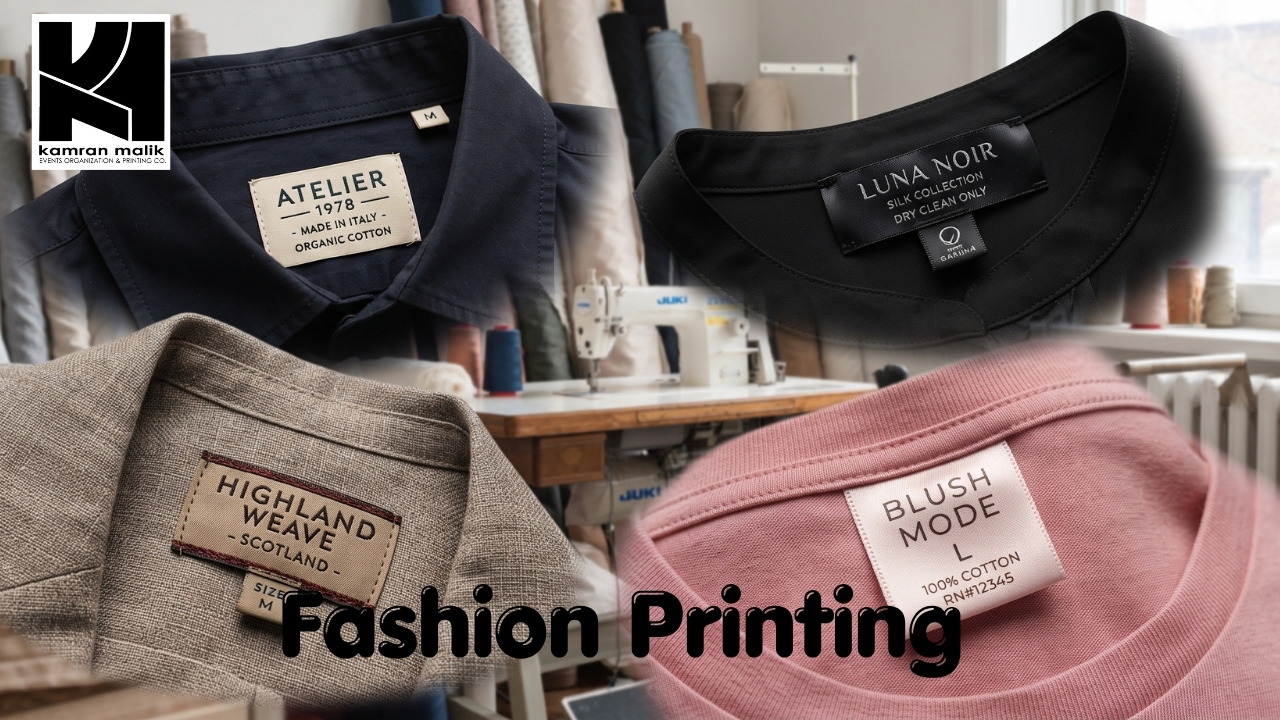
Fashion Printing for Stronger Branding
Fashion printing is a strong way to help you create your brand identity, improve the quality of garments and impress customers with its appearance. The old adage of a try-on speaks louder than the clothing in itself and okay fine, it had fond memories from eye-catching graphic tees to detailed activewear. We all know it is in the details, and nothing shows good craftsmanship as much as the finishing touches on a garment so at Kamran Malik Events— we got that covered.
In this post, we share some of the most innovative and unique fashion printing ideas that are taking the fashion world by storm and how industry-specific labeling solutions like woven labels and satin labels can elevate your brand presentation.
Why Woven Labels Are a Must-Have in Fashion Printing
Woven Labels are one of the most professional and long-lasting fashion industry labelling solutions. In contrast to printed labels that scratch and fall or peel through time, woven labels are made by weaving threads on a loom so the design will hold true from wash to wear.
Woven labels convey authenticity for brands serious about quality. A woven label also adds a pleasant texture and depth to your garment — customers appreciate the tactile experience. When a person runs their fingers across the lushly woven name or logo of a brand item, part of what they feel is that this specific brand elevates the value of the whole product.
Woven labels are used by Kamran Malik Events from the interplay of corporate uniforms to exclusive brand event merchandise, ambitiously. You can customize everything (thread colors, label shapes, font styles and backing materials) with all of this to represent the brand’s identity. From a classic center-fold label for the jacket, to a flat woven label for a tote bag; this format suits many different applications and hence is an industry staple.
Woven labels also provide differentiation in a sea of similar offerings from an SEO / branding perspective. Low-quality brands do not last long in the market, and potential clients are now looking for signals of quality to hear about a product prior to acquiring it —and a neat woven label is proof that the company cares about their item.
What Makes Fashion Printing So Impactful?
Fashion printing consists of much more than just ink on fabric. It is a declaration of identity, the means to communicate, and part of your branding. Be it streetwear line, fashion designer collection or custom event merchandise, how clothes are printed and labelled determines how much value customers attach to them.
These days, one can find many of the common techniques like screen printing, digital printing, heat transfer & sublimation in general use. Different aesthetic and practical output offered by all methods. For heavy production runs, screen printing provides solid, rich colors. Digital printing is capable of making complex photo-realistic designs. You train to create heat transfer which is perfect for on-demand production and sublimation is best when you are going with polyester based activewear.
But that printing technique is only half the narrative. Words on a label stuck to your clothing somehow also matter. Even a good quality print can’t make up for a cheap label, a poor-quality product. And this is why innovative brands are investing in higher-end labelling options that will complement the quality of their designs.
Creative Fashion Printing Ideas Worth Exploring
The most important aspect is that fashion opting provides a myriad of creative opportunities. The rule of thumb is to match your printing selections with the visual language of your signature and target audience. Here are some areas to think about.
All-Over Printing for Maximum Visual Impact
Commonly known as sublimation printing, all-over print is when a design covers the entirety of a surface on the garment. You would rule with this approach, especially for sportswear, swimwear and streetwear. By having the coverage of both need and ink combined you get a strong visual into your clothing that separates it from traditional garment decoration.
Custom Graphic Tees with Screen Printing
Screen printing is one of the foundation stones in fashion printing, especially for custom graphic tees. It is economical to scale and also supports rich, matte colors. Brands can tell a story, generate interest in an event, or capture the zeitgeist of the moment with signature graphics. Screen printed tees create branded-tee wearables that can be highly profitable when woven labels are adopted.
Embroidery and Mixed-Media Printing
In fact, nothing beats the embroidery when it gets combined with the conventional printing methods to create depth and dimension that flat prints cannot match. Interestingly, layers of digitally print on base layers with few embroidered touches give a depth and richness to fashion. That hybridised style—is hitting its stride across both high-end streetwear and haute couture alike.
Heat Transfer Vinyl for Custom Designs
This flexible printing option is great for on-demand or small-batch fashion printing. The process can be utilized on various types of fabric and enables very delicate, intricate patterns. HTV is especially favored for custom event merchandise, athletic wear and personalized clothing – where Kamran Malik Events has acquired considerable expertise.
Digital Direct-to-Garment Printing
Direct to garment printing has changed the game for small-run production. DTG printing: Direct to garment (DTG), a technology derived from modified inkjet systems, DTG lets you create photographic-quality designs—without the set up costs of screen-printing. This makes it a natural fit for limited-edition drops, artist collaborations and other bespoke fashion items.
How Fabric Choice Affects Fashion Printing Results
No discussion on fashion printing can ever be complete without including a conversation centered around the quality of fabric and print. Fabric choice really do have a big impact on ink adhesion, color appearance and durability up to 5 times!
Natural fibers, like cotton and linen, absorb water-based inks much better than any other material making them one of the highest caliber options for screen printing and DTG. As sublimation printing relies on using heat to bind dye molecules into the actual composition of the fibre, polyester and other synthetic materials are optimum.
New fabric blends bring with them their own set of challenges. With a 50/50, both screen printing and sublimation can be used however the ink formulation as well as process will differ depending on how it goes through the heat transfer. The latter lands you in steeped details which means creating timeless beautiful garments.
The Finishing Touch: Satin Labels in Fashion Printing
Satin Labels are softer than and more upscale than woven labels, which is why you will often see them in luxury items like lingerie, children’s wear, bridal clothes, and high fashion. Satin label texture can be smooth and silky with a bright sheen — which I feel would make it look classy. Another important factor when it comes to labelling inner-garments is that satin labels have a very soft-facing finish of the fabric, thus they tend to be very comfortable against sensitive skin.
Satin Labels are a Kamran Malik Events favourite and are often chosen for high end fashion print jobs where the experience of the tag is just as significant as the garment it compliments. The Satin Printing is very clear with small font and intricate logos. Satin labels can be printed in gradients or photography, so they are more suitable for brands with complex and multi-colored visual identities (unlike woven labels).
Another neat thing you could use are satin labels for event wear. There is a satin label that does justice to the type of event whether wedding wear, gala evening, or branded fashion launch. For instance, marrying between the two, a beautifully printed satin label with an eye for detail results in a packaged substance that makes customers believe that real effort is put into quality.
Ultimately, it is a bit of both when you have to choose between woven labels and satin tags — each type has its own purpose & suitability; the material that best fits what you are planning largely depends on the product functionality, your positioning in the brand landscape and customer needs. Either approach—if done correctly—is a commitment to quality and, in turn, develops brand loyalty and boosts repeat purchases.
Building a Fashion Printing Strategy That Lasts
The most effective Fashion printing methods are those that revolve around consistency, quality, and intention. Choosing the proper print method, matching it up with quality fabric and finishing off the garment feature label solutions build a seamless brand narrative from tip to tail.
Every endeavor Kamran Malik Events has pursued, from the fashion industry to the events arena, implements printing strategies that are not “just for looks.” The key is to always make clothing that looks as good as it feels, and communicates the brand proposition at every touchpoint.
Your Next Step in Fashion Printing
Fashion printing is a skill that pays close attention to detail. From all-over sublimation activity wear for the collection you’ll be launching tomorrow, perfect graphic tees for a one-off event next week, or premium-quality garments outfitted with woven labels and satin labels flying off both online sale racks and in-stores for seasons to come; your decisions at every step along the way matter in determining how successfully the end product resonates.
If you need a professional barcode system to label your fashion printing projects in addition to assistance for your new fashion weaving preprinting, make sure you choose Kamran Malik Events. Contact us now to learn how Woven Labels, Satin Labels and Custom printing can help realize the aspirations of your brand.

